
The Three Pillars of Observability

By Minutus Computing|April 07, 2026|2 min read

Full-Stack Observability: When Events Lead and Pillars Explain

A customer complains that payment is slow. Back at the engineering team, three people look at the same incident at the same time, each with a different tool.

Engineer A opens the metrics dashboard.

She sees the spike — latency crossed 3s at 14:09. Error rate is flat. CPU and memory look normal. She knows something happened. She does not know what.

Engineer B opens the log stream.

He filters to payment-service at 14:09 and sees a flood of "database query timeout" entries. He knows what happened. But he has no idea which upstream service triggered it or where in the stack the problem originated.

Engineer C opens the trace view.

She pulls a single failed request and sees the full journey: API gateway → order-service → inventory-service → payment-service → PostgreSQL. The DB call in payment-service took 2,840ms. She clicks the span, finds the query, and sees it is doing a full table scan on an unindexed column. That is the bug, found in about 90 seconds.
three pillars of observability

Pillar #4: Event — the event is the start, not the end

When customers say payments are not going through or are delayed, they are not being imprecise. They are giving you the most important signal available: something changed or broke. The investigation starts there.

What they are describing is an application event, and it is almost always earlier than any technical alert you would set. By the time your p99 latency alert fires, customers may have been failing at checkout for fifteen minutes. By the time a pod OOMKills, users may have been seeing blank screens for longer.

This is why events (business or technical) are the primary clue. They tell you when to look and roughly where. The three pillars tell you why.
Metrics are numeric measurements of system behavior collected over time. They are the signal that powers your dashboards, your alerts, and your SLOs, and they exist at every layer of your stack.

Infrastructure metrics measure the health of your underlying compute: CPU utilization, memory consumption, disk I/O, network throughput, container restarts. These are the signals that tell you whether your hosts, nodes, and pods are under stress.

Application metrics measure what your services are doing: request rate, error rate, latency percentiles (p50, p95, p99), queue depth, cache hit rate, database connection pool saturation.

A p99 latency of 2.4 seconds on /checkout means one in a hundred users is waiting over two seconds to complete a purchase — not a stat from a load test, but a live signal from your production system.

  • Fast alerting: a threshold breach triggers in seconds.
  • Trending and baselining: they show you what normal looks like, so deviations stand out.
  • SLO tracking.
  • Capacity planning.
  • What metrics miss: metrics tell you that something changed, not why.

From business event to root cause in minutes

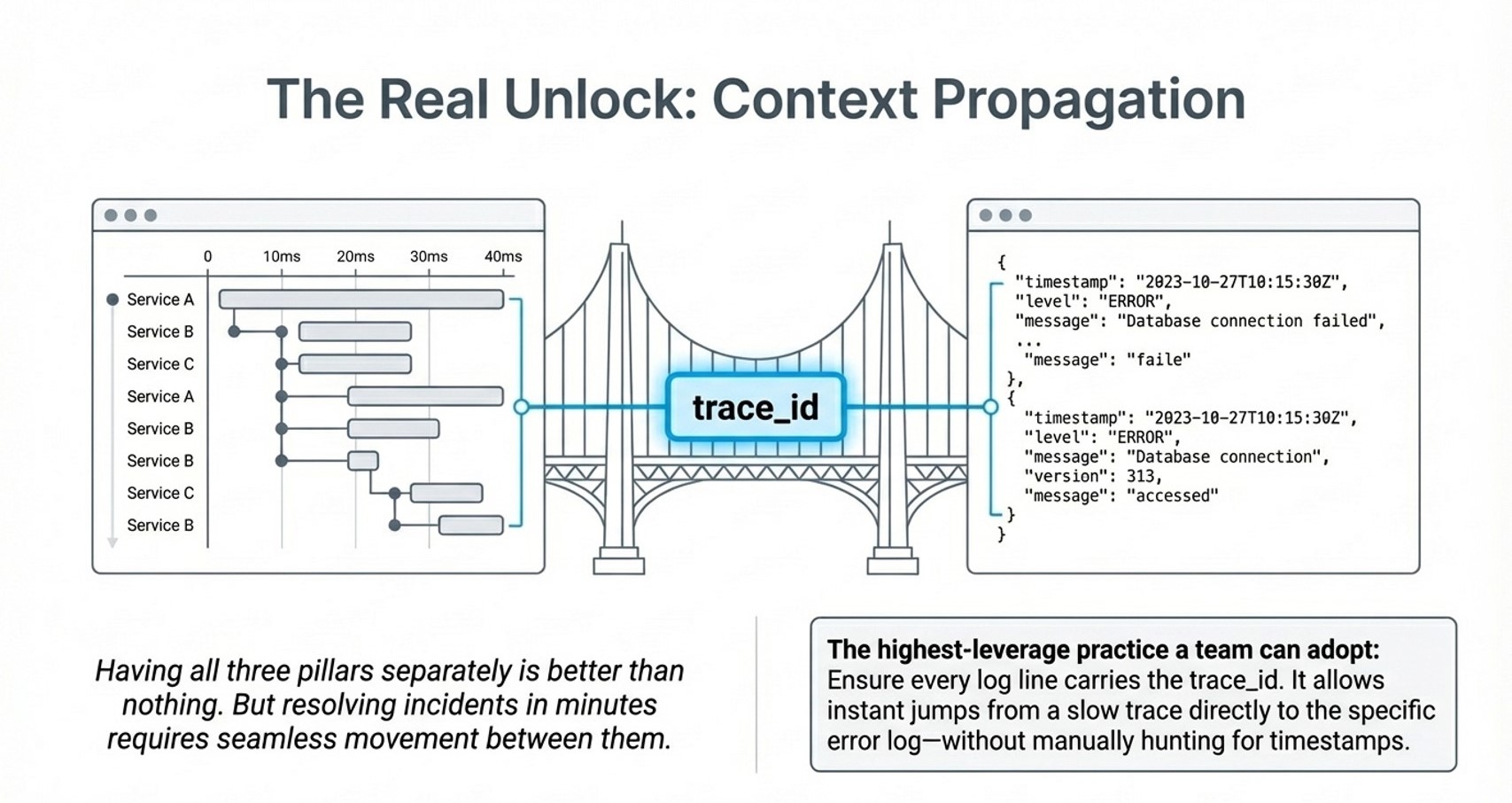
Having metrics, logs, and traces separately is far better than having none. The goal is to move seamlessly from a business event to the metrics that quantify it, to the traces that show the request path, to the log lines that reveal the cause.

  1. Business event surfaces (customer or system signal).
  2. Business metrics confirm scope.
  3. Technical metrics narrow the target.
  4. Alert links to traces; trace view shows the culprit.
  5. One click to logs; the log line reveals root cause.
  6. Total time: under four minutes — when the toolchain is wired for it.
three pillars of observability

The shift worth making

Most teams treat observability as an engineering concern: dashboards, alerts, pages to on-call. When something breaks, engineers investigate.

The teams that get this right treat observability as a business concern too. The faster you can connect signals, the less revenue you lose, the fewer customers you frustrate, and the less time your best engineers spend staring at dashboards at midnight.

The three pillars (metrics, logs, and traces) are not three separate tools to buy and maintain. They are three views of the same system. String them together, instrument business events alongside technical ones, and you stop asking whether it is an infrastructure problem, an application problem, or a business problem.

It is one system; you are seeing all of it. That is what full-stack observability actually means.

If you want to connect business and technical events with metrics, logs, and traces so your team can move from symptom to root cause faster, we would be glad to help. Reach us at sales@minutuscomputing.com.