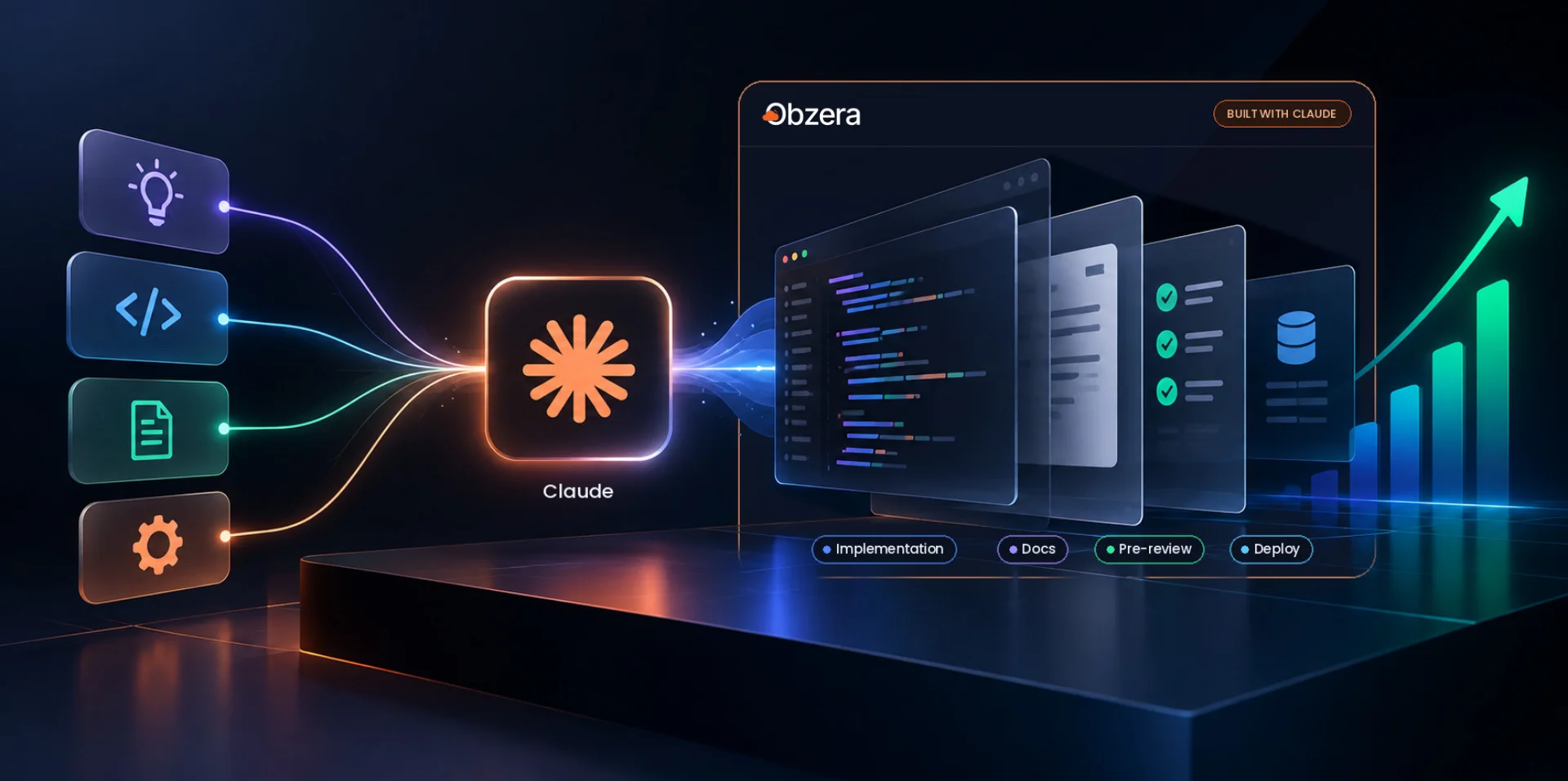
Obzera Shipped Features 60% Faster with Anthropic Claude

Overview
Obzera adopted Anthropic Claude across its development workflow, using Claude.ai for day-to-day development assistance, Claude Desktop for local coding and file-level work, and the Claude CLI for automation and scripted workflows. Together, these tools helped Obzera cut feature cycle time from 10 days to 4 days, reduce code review cycles, and improve the quality of production deployments.
Primary Goals and Objectives
Faster Feature Delivery
Shorten the cycle from feature specification to production deployment, moving from an 8 to 12 day average to under 5 days per feature.
Documentation Written Alongside Code
Ensure technical documentation is written in parallel with code, not after release, eliminating gaps that were slowing customer onboarding.
More Output, Same Team
Scale the volume of features shipped per quarter by making better use of existing capacity, with Claude handling repetitive and boilerplate tasks.
Fewer Review Rounds
Introduce a structured first pass review using Claude before pull requests are opened to human reviewers, reducing the number of feedback iterations required.
Features and Functionalities
Feature Implementation
Obzera used Claude.ai for interactive development and Claude Desktop for local coding work. For complex features like its GenAI scaling recommendation engine, Claude helped translate architecture into working Python code, cutting implementation time by roughly half.
Documentation
First draft technical documentation was written in parallel with code, including API contracts, alert configuration, and integration guides. It was ready at launch, not weeks after.
Automated Pre Review
The Claude CLI was scripted into the existing workflow to run a first pass check before each pull request. The check covered edge cases, pattern consistency, and test gaps without adding manual steps.
Context Switching Reduction
Claude Desktop handled shifts between coding and writing tasks, keeping attention on the work that required real judgment.
Key Deliverables and Milestones
Claude Integration into Development Workflow
Anthropic Claude deployed in production across Obzera's feature development process by Minutus Computing, covering implementation, documentation, and pre review phases within the first sprint of adoption.
Documentation Coverage Raised to 90%
Within two quarters, feature launch documentation completeness improved from 40% to 90%, reducing customer onboarding queries.
Feature Output Doubled
Quarterly feature releases grew from approximately 6 to approximately 12. The increase held across two consecutive quarters without additional headcount.
Claude Part of Every Release
Claude is now a permanent part of Obzera's development process from first implementation through pre merge review on every active feature.
Quantifiable Benefits
| Metric | Before Claude | After Claude | Improvement |
|---|---|---|---|
| Avg. feature development cycle | 10 days | 4 days | 60% faster |
| Review/QA cycles per feature | 3 to 5 cycles | 1 to 2 cycles | 60% fewer iterations |
| Documentation completeness at launch | 40% coverage | 90% coverage | 2× improvement |
| Time on boilerplate / repetitive tasks | 30 to 40% of dev time | <10% of dev time | 3× reduction |
| Features shipped per quarter | 6 features | 12 features | 2× output increase |
| Post-deployment bugs (first 2 weeks) | Avg. 4 per feature | Avg. 1 to 2 per feature | 50% reduction |
Challenges
Speed vs. Quality
The risk was shipping faster but shipping more bugs. Using Claude as a pre review step, and not as a replacement for review, kept quality in check. Post deployment defects dropped by about 50%.
Fitting Into Existing Workflows
Claude was rolled out in stages: first documentation, then implementation, then pre review. Each step was measured before moving to the next.
Documentation Accuracy
Claude output was treated as a first draft. A lightweight review step was added before publication to catch any gaps.
Conclusion
By deploying Anthropic Claude in production across its development workflow, Obzera reduced feature delivery time by 60%, doubled quarterly feature output, cut post-deployment bugs by 50%, and raised documentation completeness from 40% to 90% at launch, all without increasing headcount. Claude is now a standard part of every Obzera feature cycle, from first implementation through to documentation and pre merge review.